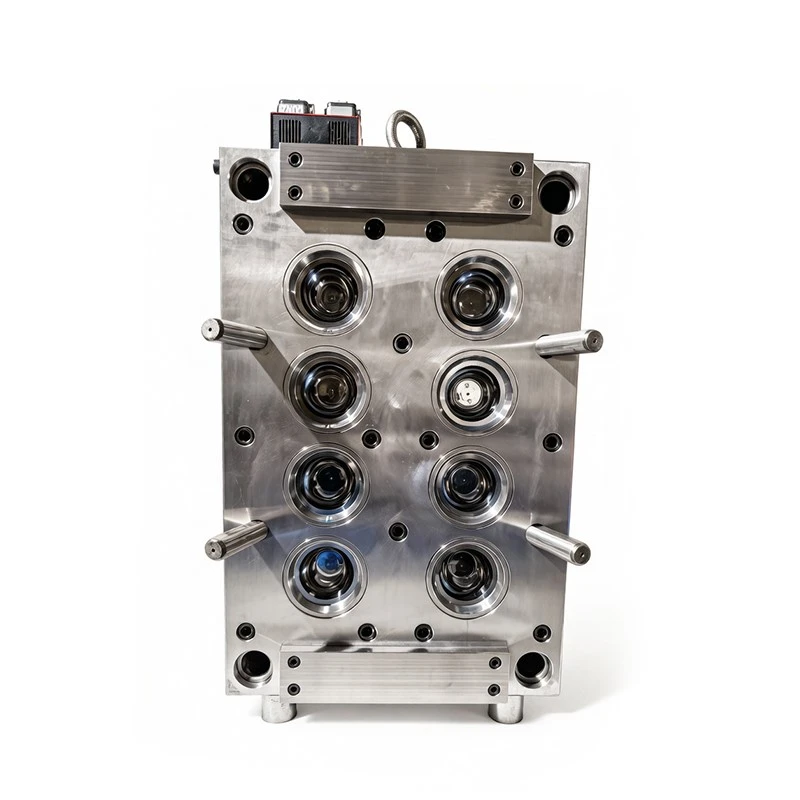

In the mineral water production chain, the preform mold serves as an "invisible bridge" connecting raw materials to the finished product. As the core tool for preform molding, the design precision and manufacturing process of multi-cavity preform molds directly impact preform quality, production efficiency, and cost control. This article analyzes the core competitiveness of manufacturers of multi-cavity mineral water preform molds across three dimensions: technical principles, design essentials, and industry applications.
The Advantages of Multi-Cavity Molds: Dual Optimization of Efficiency and Cost
Traditional single-cavity molds produce only one preform per injection cycle, whereas multi-cavity molds feature multiple independent cavities, enabling the production of multiple preforms in a single shot. For instance, an 8-cavity mold can yield eight preforms per cycle, multiplying production efficiency. This design not only shortens production cycles but also reduces energy consumption and labor costs per preform through economies of scale. For high-demand fast-moving consumer goods like mineral water, the efficiency advantage of multi-cavity molds translates directly into market competitiveness.
However, more cavities do not necessarily equate to better performance. Increasing the number of cavities raises mold complexity, potentially leading to issues such as extended cooling times and uneven cavity pressure distribution. Consequently, manufacturers must ensure consistent molding quality across all cavities by balancing runner designs and optimizing cooling systems, taking into account preform dimensions, material properties, and injection molding machine parameters. For example, employing hot runner technology minimizes runner waste, while conformal cooling channel designs accelerate cavity cooling, further boosting production efficiency.
Core Mold Manufacturing Technologies: Balancing Precision and Durability
Mineral water preforms are typically made of PET (polyethylene terephthalate), a material highly sensitive to mold temperature, pressure, and cooling rates during injection molding. Manufacturing multi-cavity molds requires overcoming two major technical challenges: first, controlling cavity precision-as micron-level errors can cause uneven wall thickness, compromising the subsequent blow-molding process; and second, ensuring mold durability-since high-frequency injection cycles can easily lead to cavity wear, necessitating the use of surface coatings or alloy materials to enhance wear resistance. Taking cavity machining as an example, manufacturers typically employ a hybrid process combining high-speed milling and electrical discharge machining (EDM). High-speed milling is used for rough machining to rapidly remove excess material, while EDM handles finishing, utilizing electrode discharges to erode metal and achieve micron-level precision. Furthermore, the design of the mold's cooling system is critical; a well-planned cooling water circuit layout can reduce cooling time by over 20% while preventing deformation or stress concentration in the preform caused by localized overheating.
Industry Trends: Smart Technology and Customization Driving Mold Upgrades
As competition in the mineral water market intensifies, brand owners' demands for preforms have become increasingly diverse. Requirements range from lightweight designs that reduce plastic usage and uniquely shaped preforms that enhance product recognition to the development of functional preforms (featuring anti-counterfeiting marks or ventilation holes), all of which place higher demands on the technical capabilities of mold manufacturers. Against this backdrop, smart molds and customized services have emerged as the industry's new direction.
Smart molds utilize embedded sensors and control systems to monitor injection pressure, temperature, and cooling efficiency in real-time, optimizing process parameters through data analysis. For instance, a smart mold developed by one manufacturer can automatically adjust cavity temperature, keeping preform wall thickness variations within ±0.05 mm. Customized services require manufacturers to possess rapid response capabilities, maintaining close collaboration with clients throughout the entire process-from preform design and mold development to trial runs and mass production-thereby shortening the time-to-market.
The technical prowess of mineral water multi-cavity preform mold manufacturers serves as the "invisible guardian" of preform quality and production efficiency. From efficiency optimization in multi-cavity designs and precision control in manufacturing processes to leading trends in smart technology and customization, every step embodies the deep integration of materials science, mechanical engineering, and data technology. For consumers, the "birth" of a bottle of mineral water may seem to occur in the instant the cap is twisted open; for mold manufacturers, however, it represents the culmination of countless technical iterations and process innovations.